A Ferret’s Second Chance: From a Crow Attack to a Warm Blanket
It started as a scene of pure panic. A small ferret, alone and terrified, was running for its life down a sidewalk while a flock of crows swooped and chased. What followed was a quiet, tender rescue that turned fear into safety, and vulnerability into trust.
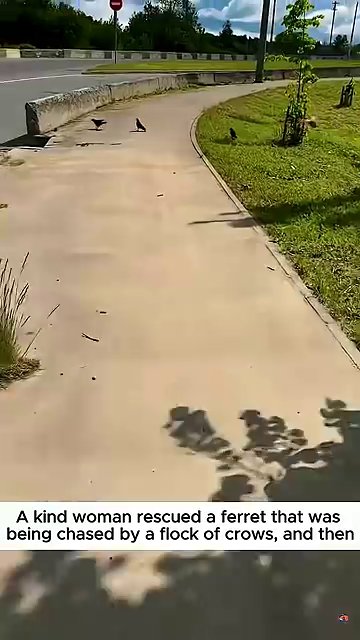
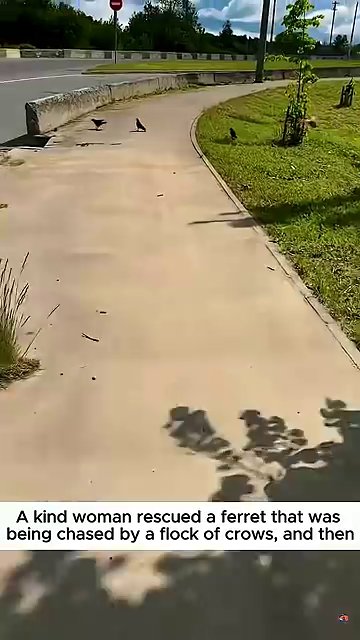
The world can be a harsh place for a small animal caught out in the open. For this ferret, the morning began with a desperate sprint on a narrow strip of concrete, with a road on one side and grass on the other. The crows weren’t just following—they were hunting. Their instinct to harass or attack a small, fleeing creature is brutal, and for a ferret far from any burrow or hiding spot, the odds were not good.
But then a person stepped in.
The Rescue
The first thing you notice in the rescue footage is the sheer speed of the intervention. One moment the ferret is running, the next it’s being scooped up into safe hands. That moment of transition—from prey to protected—is everything.
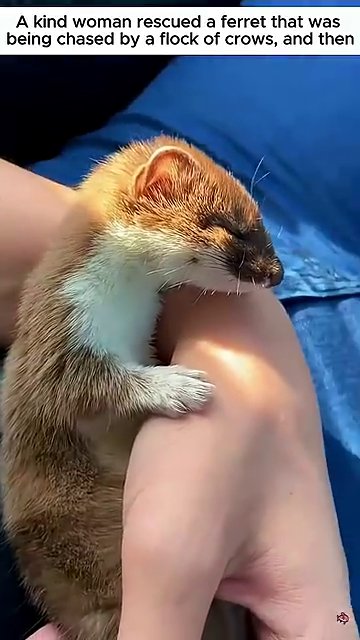
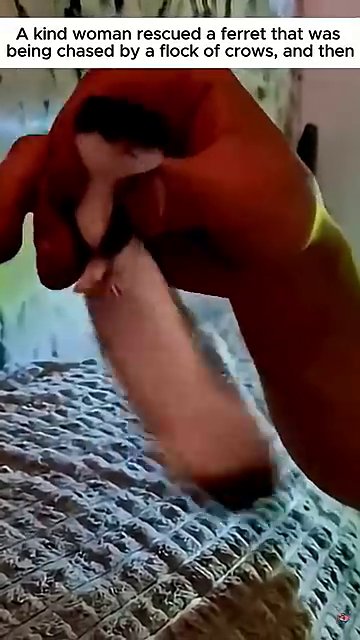
By the time the camera focuses on the ferret close-up, it’s already in a state of exhaustion. Its eyes are closed, and it lies limp along the length of a person’s arm. The small brown body, marked with white patches, is completely still. This is an animal that has burned through its last reserves of energy. The chase, the fear, the adrenaline—it all caught up at once.
This is where the story shifts from a rescue to a recovery. Holding a wild or domesticated animal that has just gone through trauma requires patience. You don’t jostle it. You don’t make sudden movements. You let it feel the warmth of your hand and the steady rhythm of your heartbeat. You let it understand, in its own animal way, that the danger is over.
Cleaning and Care
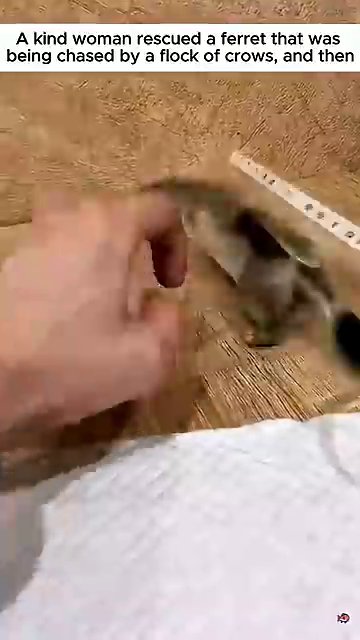
Once the ferret was safe, the next step was addressing its physical state. A gloved hand appears in the next images, gently wiping or cleaning the ferret’s fur. This is delicate work. The animal is still in a state of shock, and any rough handling could send it back into panic mode.
Cleaning a rescued animal isn’t just about hygiene. It’s also about assessment. You check for wounds, for signs of dehydration, for parasites, for injuries that might not be visible at first. The crows’ beaks can cause deep puncture wounds, and a ferret that has been running on pavement might have scraped paws or damaged claws. The rescuer’s gentle touch suggests someone who knows what they’re doing—someone who understands that the first few minutes of care set the tone for the entire recovery.
The ferret, for its part, stays still. It doesn’t struggle. It doesn’t try to bite or flee. That’s a good sign. It means the animal is beginning to trust, or at least has exhausted its fight-or-flight response and is willing to accept help.
A Moment of Alertness
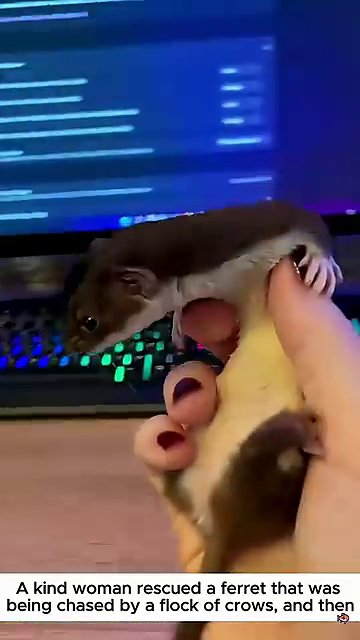
The next image is where the story turns. A hand with purple-painted nails holds the ferret, and this time, the ferret’s eyes are open. It’s looking around. Its head moves. It’s no longer a limp, unconscious creature—it’s a curious, alert animal taking in its new surroundings.
This is the moment every rescuer lives for. That shift from “I’m dying” to “I’m okay.” You can see it in the eyes. The fear is still there, but it’s no longer overwhelming. The ferret is starting to process the fact that the hands holding it are not a threat. They’re warm. They’re steady. They smell like safety.
The purple nail polish is a small detail, but it matters. It reminds you that this rescuer is a real person—someone with a life, a personality, a sense of self. They weren’t on duty. They weren’t wearing a uniform. They just saw an animal in trouble and acted. That’s what rescue looks like in the real world. It’s not always a team of professionals with equipment. Sometimes it’s just one person who stopped to help.
The New Environment
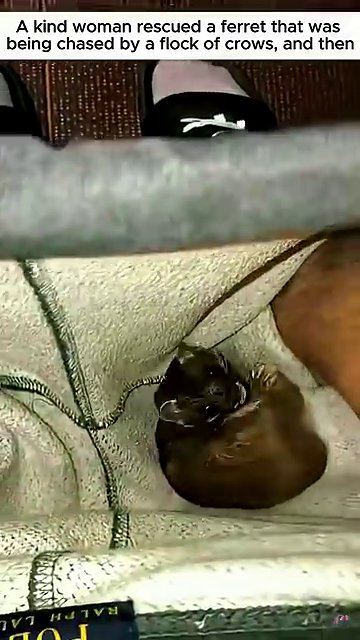
The final image in the sequence shows the ferret curled up in a blanket or towel, resting in what appears to be a person’s lap. A book is partially visible underneath the blanket, suggesting a quiet, domestic setting. The ferret is no longer on a cold sidewalk, no longer being chased, no longer alone.
This is the happy ending, but it’s also a beginning. A rescued animal doesn’t just need one good day—it needs ongoing care. Ferrets are intelligent, social animals. They need proper nutrition, a safe enclosure, veterinary checkups, and social interaction. A ferret that has been through a trauma like this may also need time to rebuild trust with humans.
But the first step is always the same: get them warm, get them safe, get them calm. Everything else comes after.
What This Rescue Teaches Us
There are a few things worth taking away from this story.
First, never underestimate the danger that common urban birds can pose to small animals. Crows, magpies, and even seagulls will attack small mammals if they perceive them as vulnerable or as competition. A ferret, a kitten, a small rabbit—these animals can be targeted even in seemingly safe neighborhoods.
Second, the value of immediate, gentle intervention cannot be overstated. The rescuer in this story didn’t hesitate. They didn’t wait to see if the ferret would escape on its own. They stepped in while the attack was happening. That decisiveness likely saved the ferret’s life.
Third, recovery is a process. The ferret didn’t bounce back in five minutes. It went from unconscious to alert over a period of time, and only after being held, cleaned, and comforted. If you ever rescue an animal, be patient. Don’t expect instant gratitude. Don’t expect the animal to understand what you did for it. Just give it time and space to realize that it’s safe.
For those who have never rescued an animal before, stories like this one can feel almost too simple. A person found a ferret, picked it up, cleaned it, and held it. That’s it. But anyone who has actually done this knows that it’s never that simple. There’s the fear of being bitten. There’s the uncertainty of whether the animal is injured internally. There’s the question of what to do next—keep it, take it to a shelter, find its owner?
The rescuer in this story handled it with quiet competence. No drama. No hesitation. Just action and care.
A Final Thought
The ferret in this story is lucky. It was in the wrong place at the wrong time, but it was also in the right place at the right time—because someone was there to help. That’s the thin line between tragedy and a second chance.
If you ever find yourself in a similar situation, remember this: you don’t need to be an expert. You don’t need special equipment. You just need to care enough to stop, to reach out, and to hold on.
The ferret will do the rest.